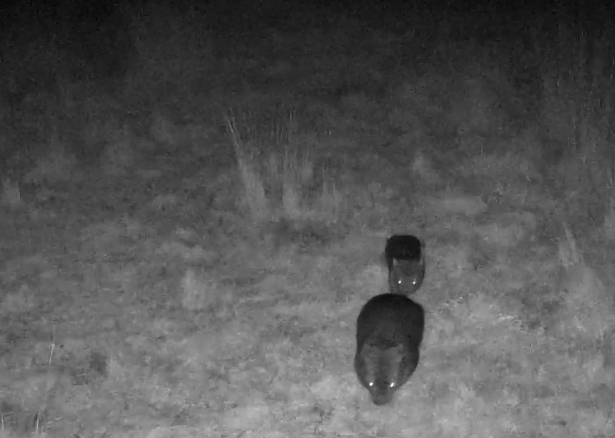
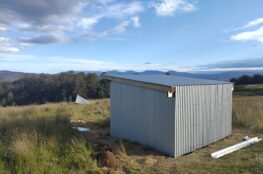
We built the shed to store the tech: mostly a camera to spy on whoever wanders past—pademelons, possums, wallabies—and to glare menacingly at any would‑be thieves. If you want the saga of actually building the shed, that’s over here.
I only got to the tech setup a few days before we had to leave, because it turns out “shed panic” and “calmly build off‑grid network infrastructure” are mutually exclusive states of being. I was… not operating as my best self.
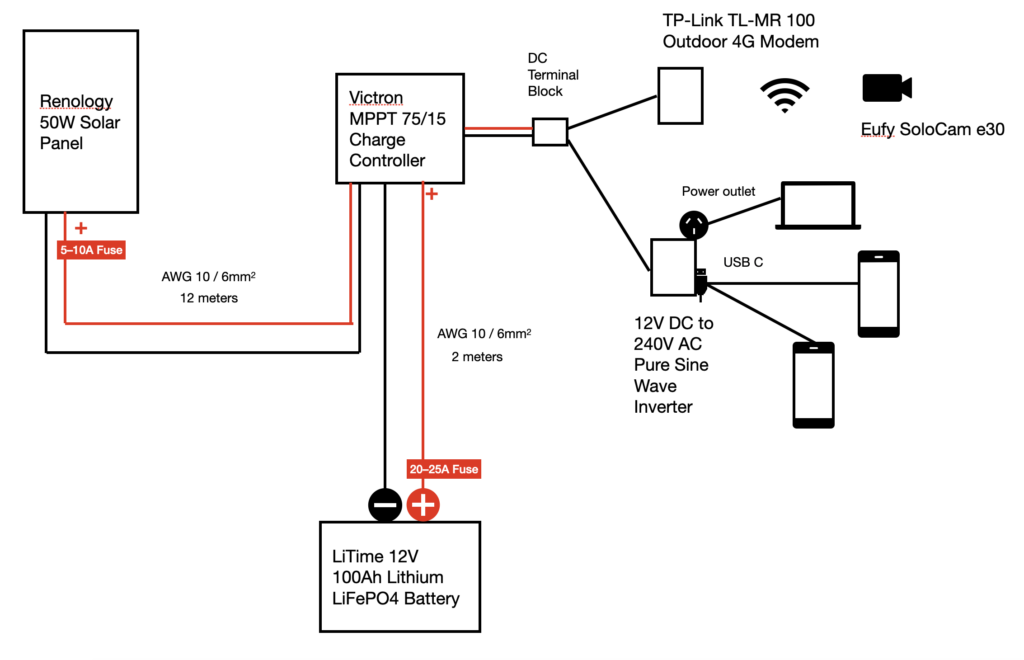
If you want the nerdy shopping list, that’s in an earlier post. This one is about the glamorous world of cables, connectors, and blown fuses. This was the plan based on my research.
I did intend to do all the connectors and cabling myself—learn a new skill, be self‑sufficient, very wholesome. But my eSIM turned out to be useless, the shed was eating all the time, so I pivoted to a new strategy: find a local expert and throw money at the problem.
Off I went to the nearest solar shop (EveryBattery) which looked mid‑way through a going‑out‑of‑business sale: mostly empty shelves and one frazzled guy juggling a phone call and two walk‑ins. I asked about cable specs, despite having absolutely no idea how far anything would be from anything. We settled on 12 metres of 6mm twin core—overkill, which of course I only learned afterwards.
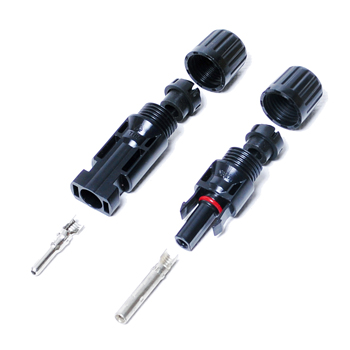
Then came the MC4 connectors—the little plugs that let the solar panel talk to the charge controller and are basically the default connector for modern solar setups. I made the mistake of asking how to install them. Ten minutes later, after a full technical monologue ending with “and if you don’t do it in that exact order you WILL break them,” I just asked how much it would cost for him to do it. The answer: not much. Sold. Why would you do it yourself?
Time. Time is why. He didn’t finish them for two days, which stacked nicely on top of the already rising stress of the fast‑approaching deadline.
While waiting, I drove off to get a Telstra prepaid data SIM, slightly convinced it wouldn’t work in the modem despite all my careful research. Only one way to find out. It did work and I was actually pleasantly surprised by tech for once.
Eventually I accepted that Frazzled Guy was not going to be of much use and his shop didn’t have half the bits I needed anyway. Enter alternative store (Jaycar): a much better‑stocked place where a young guy got gently charmed (bullied) into helping me and ended up wiring my whole setup—once I agreed to buy the crimping tools he needed to use. Thanks, Jordan. You’re a star.
Jordan cabled everything, crimped all the connections properly, and added fuses on the positive lines so that, in theory, nothing important would explode, including me.
Once the MC4 cables finally came back from Frazzled Guy, I could actually build the basic system: solar panel → controller → battery, with the modem on the controller’s load output – cause I realised I wasn’t going to get the inverter in the build so no point complicating the setup with a terminal block and more crimping. I flipped it on and—bam—off‑grid internet. I felt like a god.
This lasted right up until I managed to touch both battery terminals with a wrench at the same time and crack. I didn’t realise it then, but I’d blown the fuse. Without that fuse, I would probably have ended up with a very hot wrench welded to the battery, so honestly, 10/10 design.
What followed was an extremely frustrating period of me trying to figure out why the modem kept power‑cycling the moment the solar panel wasn’t in full sun. It turned out the blown fuse meant the battery wasn’t actually connected, so there was only just enough power from the panel in indirect light to boot the modem before it immediately died again. On, off, on, off. A sad little rave.
With about 24 hours left before we had to catch the ferry, I gave up. No internet, no clue, no time. I packed everything into boxes and sulked. Then we made the decision to delay our ferry by two days so I could have one last shot at getting it working.
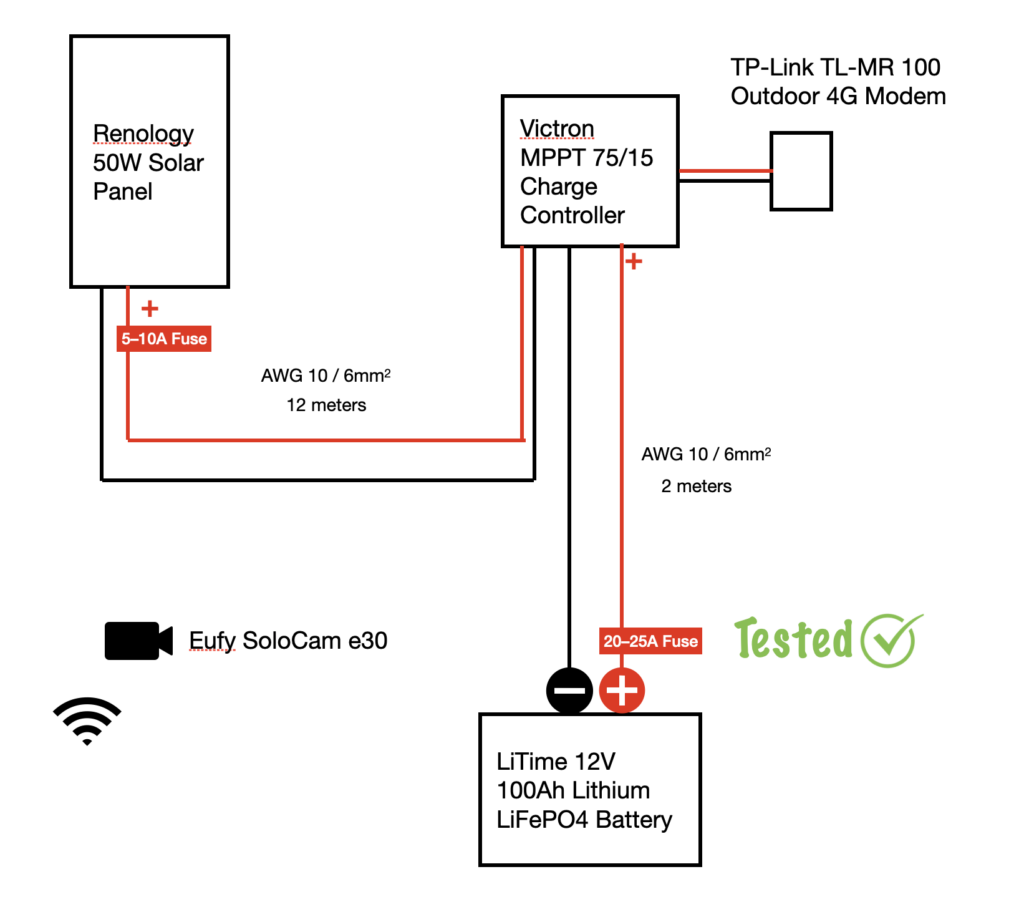
I raced back to Jordan. He wired the system up, stared at the weird behaviour with me for a bit, then casually pulled the fuse. Aha!! He popped in a new one, everything sprang to life, and I immediately bought a handful of spare fuses because the shop is a 40‑minute drive away.
I sped back to The Brink, cabled it all together again, and this time it worked perfectly—and still does. And this is what actually got installed – slightly simpler setup than the original plan but enough to fulfill the original objective of having a crittercam, remotely accessible.
Now, every night, I get clips of padymelons having punch‑ups in front of the shed, possums casually moving in, and wallabies sparring at dawn. And just the other night, I hit the jackpot: wombats. A mum and baby wombat casually wandered straight through the camera trap like they were on a red carpet.
Who knows how long the connection will hold, but for now, I’m very, very happy.

May 31, 2026
[…] to think about version 2 of the solar setup. Version 1 is in this post. I’m still mildly amazed it’s all running, given it was thrown together in a hurry by someone […]